 |

|
||||
 FEDERAL JOBSEEKER NEWSLETTER FEDERAL JOBSEEKER NEWSLETTER
Pay is only part of the compensation you will earn working for the Federal Government. The Federal government offers a broad array of benefits programs and family friendly flexibilities to meet the needs of you and your family. Here are some highlights. Look for additional information along with links to pages that spell out the details below.
In addition to these programs, the Federal Government recognizes the need for income replacement and income support benefits down the road.
As a new employee, individuals may be eligible for some special bonuses such as a recruitment bonus or a relocation bonus. This will be at the discretion of the employing agency. Other beneficial federal programs employees may want to ask about include: incentive awards; employee development programs; student loan repayment programs; retention allowances; and interagency transfers. All agencies support community service and encourage participation in the annual combined Federal campaign. Federal Employees Health Benefits Program (FEHB) The Government's health benefit program has about 180 health plan options throughout the United States , including consumer-driven health care and preferred provider network options. At least a dozen plan choices are available to each employee, which allows for a broad choice so that employees can select the plan that best meets their own individual health care needs. While specific benefits vary among FEHB plans, none can impose a waiting period or require a medical exam to enroll in their plan. Flexible Spending Accounts (FSA) FSAs allow employees to increase their disposable income because the amounts they contribute are not subject to Federal income, FICA, State or local income taxes. The Federal Government offers both a Health Care FSA and a Dependent Care FSA. Employees can use the Health Care FSA for expenses that are tax-deductible, but not reimbursed by any other source, including out-of-pocket expenses and non-covered benefits under their FEHB plans. Some examples are non-covered dental services, lasik surgery, health plan deductibles, and co-payments and coinsurance. FSAs for dependent care are available for employees with dependent children or qualifying dependent adults when the care is necessary to allow the employee to work. Leave and Holidays Federal employees are entitled to at least 13 days of vacation leave as well as 13 days of sick leave each year. Depending on years of service, employees can earn up to 26 days of vacation leave each year. In addition, Federal employees get 10 days paid holiday each year. This allows employees time to spend with their families and to pursue their own individual interests and avocations. Family Friendly Flexibilities The Federal Government provides many programs for workers to support their needs for individual flexibility. For example, Flexible Work Schedules allow employees to adjust their work hours in order to take a day off each pay period. Employees can enjoy twenty-six 3-day weekends! Also, the Federal Government's Alternative Work Schedule (AWS) allows employees to select certain arrival and departure times that best suit their needs within their working day. Agencies are encouraged to allow eligible employees the opportunity to Telework either at home or at a remote location at least one day a week. Family Friendly Leave Policies provide flexibility for military leave, allow employees to care for a sick family member or flexibility in the event of a disaster or emergency. In addition, while specific programs may vary, agencies also offer Employee Assistance Programs (EAP); Part-Time & Job Sharing Positions; Resources for Child & Elder Care Resources, Information and Incentives for Adoption, and other Child Support Services. Federal Employees Retirement System (FERS): Retirement benefits are based on your years of service and salary history. Thrift Savings Plan (TSP): With the Thrift Savings Plan, individuals can self-direct their retirement savings program through multiple investment options. This Plan is very similar to a 401(k) plan. Social Security: Federal employees will earn Social Security credit while working with the Government. Social Security provides for individual’s future retirement benefits, provides disability protection, and allows for survivor benefits protection. Retirement: New employees who had previous Government service may be eligible to participate in the Civil Service Retirement System. Check opm’s website for eligibility. Medicare - Part A: Government employees are automatically eligible for Medicare Part A at no cost beginning at age 65. Federal Employees Group Life Insurance (FEGLI): FEGLI is a group term life insurance program. It consists of Basic life insurance coverage and three options. In most cases, if you are a new Federal employee, individuals are automatically covered by Basic life insurance and your payroll office deducts premiums from your salary unless you waive the coverage. In addition to the Basic, there are three forms of Optional insurance that you can elect. (Standard, Additional, and Family). The program offers the opportunity to retain your coverage for your entire life. Long Term Care Insurance Program: As a new federal employee, you have the opportunity to apply for long term care insurance under the Federal Program with minimal underwriting. However, a limited number of medical conditions will prevent a new employee from being approved for coverage. Long term care helps people to perform daily activities if they have an ongoing illness or disability. This Program offers a choice of benefits that can provide a variety of services, including but not limited to: nursing home care, assisted living facility care, adult day care and at home care. Please see the link for specific information. There are many other benefit programs that make the Federal Government a model employer and a top ranking career choice. The following is a list of additional programs offered by many of the agencies:
Lump-sum bonus to newly appointed employees for difficult-to-fill positions. Up to 25% of basic pay may be paid prior to employee entering on duty. Service agreement with repayment plan if service time not fulfilled.
Lump-sum bonus for difficult-to-fill position in a different commuting area; up to 25% of basic pay. Service agreement with repayment plan if service time not fulfilled.
Continuing payment to retain departing employees; up to 25% of basic pay.
Monetary; Time off; Honorary; Non-monetary
Career Resource Centers; Training Opportunities
Annual Combined Federal Campaign
Transfer from one Federal agency/position to another without a break in service.
Permits agencies to repay the student loans of Federal employees; used at the discretion of the agency.
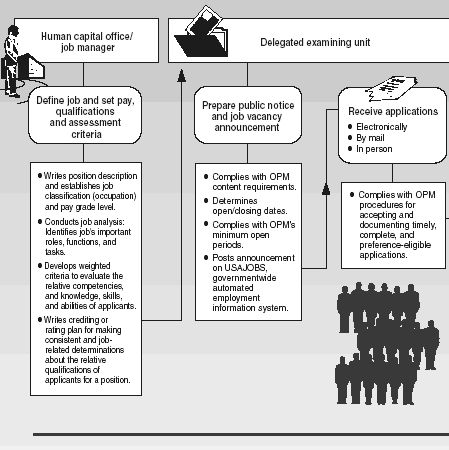
HOW FEDERAL JOBS ARE FILLED Drafting an effective super-specialized federal resume to meet current federal hiring and OPM requirements, one that will standout and actually be carefully read and seriously considered by human resources specialists who are overwhelmed with resumes and considered by hiring officials takes expert knowledge of federal personnel laws, as well as the federal hiring and selection processes. To complicate matters, each federal agency has their own hiring policies and procedures. Today, simply listing your experience, training, awards, qualifications, knowledge, skills and abilities, etc., on paper no matter how good you think they are is generally not enough to secure a highly competitive federal job. With good paying jobs harder and harder to find, more and more people are turning to the federal government for its benefits, job security and diversity of work and career advancement opportunities. Each of our expert editors are private consultants in their own right; having actually worked for the federal government themselves, each of our editors has the requisite knowledge, skills and abilities in virtually every facet of federal employment to effectively help any federal jobseeker applying to any federal position within the federal government. COMPETITIVE AND EXCEPTED SERVICE
Competitive service jobs are under OPM's jurisdiction and subject to the civil service laws passed by Congress to ensure that applicants and employees receive fair and equal treatment in the hiring process. These laws give selecting officials broad authority to review more than one applicant source before determining the best-qualified candidate based on job-related criteria. A basic principle of Federal employment is that all candidates must meet the qualification requirements for the position for which they receive an appointment. Excepted service agencies set their own qualification requirements and are not subject to the appointment, pay, and classification rules in title 5, United States Code. However, they are subject to veterans' preference. Some Federal agencies, the Federal Bureau of Investigations (FBI) and the Central Intelligence Agency (CIA) have only excepted service positions. In other instances, certain organizations within an agency, or even specific jobs may be excepted from civil service procedures. Positions may be in the excepted service by law, by executive order, or by action of OPM.
SOURCES OF ELIGIBLES
Agencies in the competitive service are required by law and OPM regulation to post vacancies with OPM whenever they are seeking candidates from outside their own workforce for positions lasting more than 120 days. (Agency, in this context, means the parent agency -- i.e., Treasury, not the Internal Revenue Service.) These vacancies are posted on OPM's USAJOBS and posted with State Employment Service Offices. The vast majority of our customers contact us after finding vacancy announcements they want to apply to on USAJOBS, the Federal Government's Employment Information System. Once a suitable number of vacancy announcements are identified by the federal jobseeker, the appropriate staff expert editor with specialized knowledge of the target agency and position is assigned to create an effective federal resume for that particular agency’s hiring officials. We know the key is getting your foot in the door, once “you’re in,” it’s relatively easy to transfer or lateral within the federal system. Our concern is getting you in, once “you’re in” the federal system, we properly update and revise your federal resume for free throughout your entire federal career! AND, our commitment to you does not stop there, as a FEDeral Resume Experts’ customer, you will be entitled to the following free federal jobseeker services, all at NO COST:
AREA OF CONSIDERATION The area of consideration is listed on the vacancy announcement and is the source from which the agency will consider candidates. The agency may designate whatever area of consideration it considers appropriate. A candidate who is outside the area of consideration will not be considered.
VETERANS' PREFERENCE Veterans' preference recognizes the economic loss suffered by citizens who have served their country in uniform in times of strife, restores veterans to a favorable competitive position for Government employment, and acknowledges the larger obligation owed to disabled veterans. Historically, Congress has reserved preference for those who were either disabled, who served in combat areas or during certain periods of time. Veterans who qualify as preference eligibles (meaning they typically must have served on active duty for at least 2 years during a period of war or in a campaign or expedition for which a campaign badge is authorized, or be disabled) are entitled to an additional 5 or 10 points added onto their earned rating in a competitive civil service examination. In all other situations (for example, selection from a merit promotion list or other "internal" action such as reassignment, transfer, or reinstatement), veterans' preference is not a factor. Veterans' preference was intended to give eligible veterans an extra assist in getting a job with the Government and in keeping it in the event of a reduction in force. Veterans' preference does not guarantee the veteran a job. Veterans' preference should not be confused with the special appointing authorities such as the VRA, which allow eligible veterans to be appointed noncompetitively to the competitive service.
THE VETERANS EMPLOYMENT OPPORTUNITIES ACT (VEOA) This act gave veterans who qualify as preference eligibles and veterans with 3 or more years of continuous active service access to jobs that might otherwise be closed to them. When an agency advertises for candidates outside its own workforce under merit promotion procedures, it must allow these veterans to apply. Of course, all applications are subject to any area of consideration that the agency has specified on the vacancy announcement. Thus, if the agency will only accept applications from status candidates within the local commuting area, veterans who are outside the commuting area are not eligible. AS OF: 10-30-00
Federal jobseekers ask us all the time, “why should I pay for a resume writing service when I can write my own Federal resume?” Answer: Anyone can write a resume or input his or her information to create a resume, but unfortunately not everyone who submits his or her resume to the Federal government gets a Federal job. While no one can legally guarantee you a Federal job, Federal employment is easily attainable provided you have a thorough knowledge of the Federal hiring process and know how to write an effective Federal resume for the applicable vacancy announcement and for the particular Federal agency, WE DO! A properly formatted and worded Federal resume, which matches the targeted Federal agency and its dynamics, is as important as a properly written KSA to get a Federal job. Not unlike people, all Federal agencies are not alike. Each agency has its own mission and therefore its own dynamics. You do not, meet, greet, and speak to everyone you encounter on a daily basis the same because every situation is different and requires special handling; the same logic applies to the Federal application process. The only thing that should remain constant is change, not your Federal resume. Nor should you submit the same Federal resume for each vacancy announcement. This is the #1 mistake made by Federal jobseekers! Automated hiring systems, like the one the U.S. Office of Personnel Management (OPM) utilizes to help candidates applying for Federal jobs, do not hire people, people do. Understanding Federal agencies, their people and the Federal hiring process is what we do. OPM’s automated hiring system is merely used to “identify” a pool of candidates through a cookie cutter approach that leaves every candidate’s application “looking” exactly the same. However, people must still determine what attributes automated hiring systems will measure, determine how these systems will measure those attributes, monitor the operation of these systems, and ultimately make selection decisions. Although every Federal hiring official is responsible for complying with applicable OPM rules and regulations, each Federal agency is responsible for their own hiring processes. Understanding Federal agencies, their people and the Federal hiring process is what we know. Under Federal law,
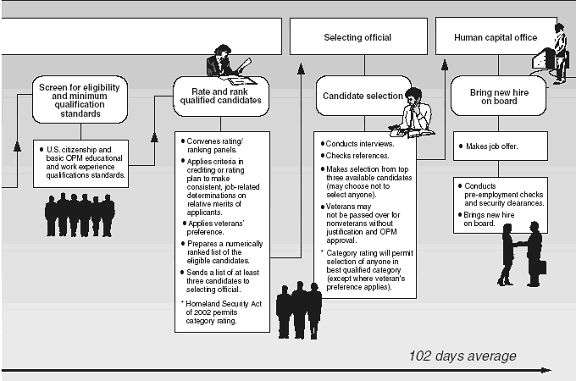
agencies make selections from within the highest quality category regardless of the number of candidates (i.e., the rule of three does not apply any longer).
Once a hiring panel has rated and ranked the candidates and applied applicable veterans’ preference points, the panel
begins calling best qualified candidates in for an interview. If a candidate with veterans’ preference is on the list, the selecting official cannot by law pass over the veteran and select a lower ranking candidate without veterans’ preference unless the selecting official’s objection to hiring the veteran is sustained by OPM. 5 U.S.C. Section 3318. However, this rarely happens and the candidate with veterans’ preference is normally selected over the non veterans’ preference candidate. This leaves the typical candidate in direct competition with potentially hundreds of other candidates with similar backgrounds and often times similar looking Federal resumes when a candidate uses an automated hiring system like OPM’s. Unless you are familiar with each agency’s hiring processes and are generally aware of what hiring officials in each Federal agency typically look for in candidates to fill positions within their Federal agency, you have no discernable advantage over any other candidate applying for the same Federal position when you write your own Federal resume or use an automated hiring system like OPM’s. Understanding Federal agencies, their people and the Federal hiring process is what we know best. FEDeral Resume Experts specialize in one thing, writing effective federal resumes that get results!
A monthly publication courtesy of the Federal Resume Experts® Staff |